If you already run Yoast SEO or Rank Math, you already have an FAQ block. Both are free, both add FAQ schema, and neither needs another plugin. So is there any reason to install an FAQ plugin like Happy FAQs?
Sometimes there isn't, and we'll say so. We make Happy FAQs, so read this with that in mind. We put the same two questions into all three on WordPress 7.1, checked what visitors see and what schema each one prints, and tested what happens when you use two of them on one page.
The short answer
- Use your SEO plugin's FAQ block for a short FAQ section at the end of a blog post or a single page, when you're happy with the questions showing as a plain list.
- Use Happy FAQs when the same questions belong on many pages, when you sell with WooCommerce, when you want a collapsible accordion with no code, or when you want a help center page.
- Don't use both on the same page with schema switched on in both. You'll get two FAQPage blocks.
At a glance
"Free" means the free version on WordPress.org. Installs, ratings and versions are from WordPress.org on October 27, 2026.
| Yoast FAQ block | Rank Math FAQ block | Happy FAQs | |
|---|---|---|---|
| Comes with | Yoast SEO 28.8 (10+ million installs) | Rank Math 1.0.280 (4+ million installs) | Its own plugin (1,000+ installs) |
| Price | Free | Free | Free, Pro from $29.99/year |
| How it looks | Plain list | Plain list, questions as h3 headings by default | Accordion, several layouts |
| FAQ schema | Yes, inside Yoast's schema graph | Yes, inside Rank Math's schema graph | Yes, one FAQPage per page; can be turned off per block |
| Where the questions live | Inside that one post | Inside that one post | Per page, or in a reusable FAQ library |
| Same FAQ on many pages | Copy it to each page | Copy it to each page | Write once, show anywhere |
| WooCommerce product FAQs | No | No | FAQ tab, by product, category or tag |
| Search, help center, AI writing | No | No | Yes, free |
What visitors see
Our test sites ran WordPress 7.1.3 with the Twenty Twenty-Five theme and PHP 8.2, in WordPress Playground, with default settings. Each page got the same two questions about shipping and returns.


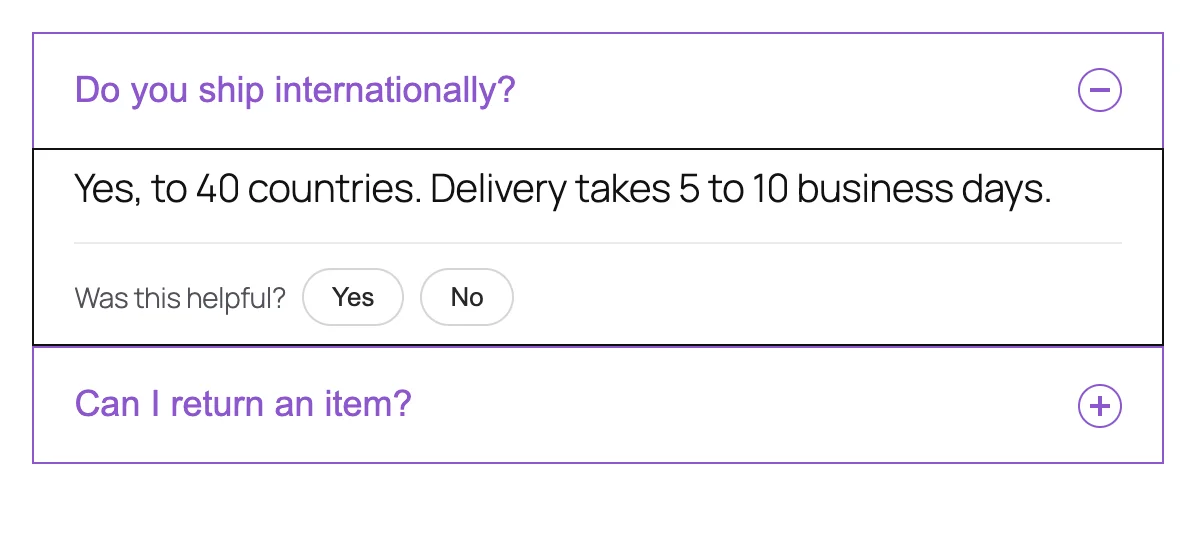
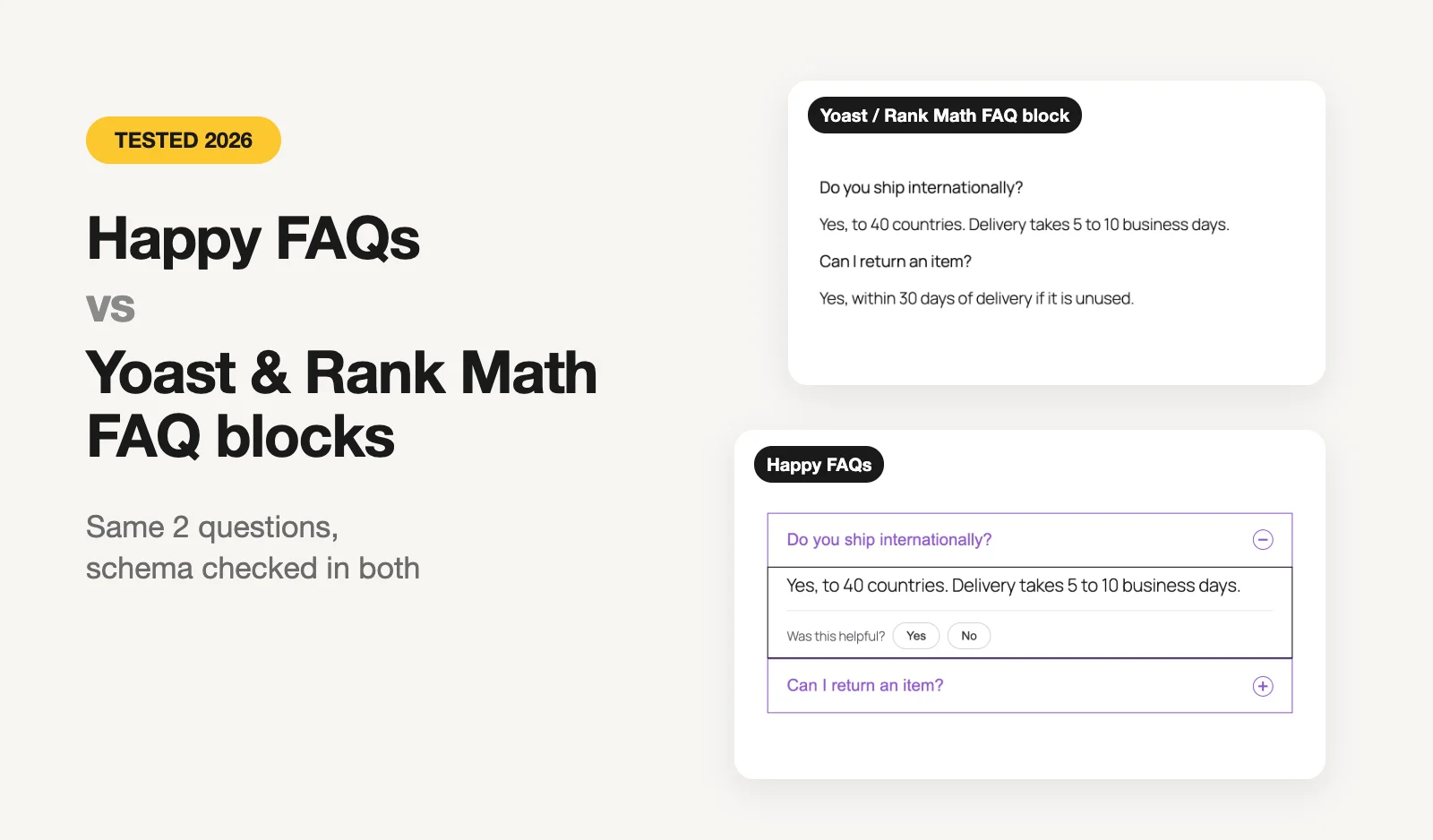
Neither SEO block opens and closes. Both print every question and every answer, one after another. That's fine for three questions at the bottom of an article. With ten or fifteen it becomes a long wall of text, and you'd need custom CSS and JavaScript, or a separate accordion block, to make it collapse.
There's one small difference between the two. Yoast marks each question as bold (strong) text, though Twenty Twenty-Five shows it at normal weight. Rank Math makes each question an h3 heading by default, so it adds to your page's heading outline. You can change that in the block's settings, along with a numbered or bulleted list style.
Happy FAQs shows an accordion by default and has other layouts, colors and icons in the block's sidebar. It also adds a helpful vote under each answer and can show a search box above the questions.
FAQ schema
All three add FAQPage schema, and all three got it right in our test: two questions, two answers.
- Yoast adds the FAQ to the schema graph it already prints on every page. The page becomes a WebPage and an FAQPage, with each question as its own node.
- Rank Math does the same inside its own graph.
- Happy FAQs prints one separate FAQPage block for all the FAQs on the page, and leaves out repeats if the same question appears twice. Each Happy FAQs block has its own schema switch, so you can turn it off on one page and keep it everywhere else.
One thing to know before you add FAQs for search: since August 2023, Google shows FAQ rich results only for a small group of well-known government and health sites. Schema still tells search engines and AI tools which text is a question and which is its answer, so it's worth having, but it won't put expandable questions under most sites' search results. We cover this in more detail on our FAQ schema page.
Using both on one page
This is the mistake to avoid. We put a Yoast FAQ block and a Happy FAQs block on the same page. The page then had two FAQPage entries: one in Yoast's graph and one from Happy FAQs. Rank Math with Happy FAQs gave the same result. Neither plugin knows about the other's FAQs.
Two FAQPage entries on one page don't break the page, but search engines get two separate FAQs for one page, which is confusing and harder to check in a schema validator. The fix is simple:
- use one FAQ block per page, or
- keep both blocks and switch off "FAQ schema" on the Happy FAQs block for that page. We tested this: the Happy FAQs schema disappeared and Yoast's stayed.
Pages with only Happy FAQs were fine. Yoast and Rank Math didn't add any FAQ schema of their own there, so there was just the one FAQPage from Happy FAQs.
Where the SEO plugin's block is enough
- You already use Yoast or Rank Math. Nothing else to install, update or keep compatible.
- The questions belong to one post. A "Questions about this recipe" or "FAQ about this guide" section that won't appear anywhere else.
- A short list is fine. Three to five questions read well without an accordion.
- Schema in one graph. If you care about everything sitting in one connected schema graph, the SEO plugin's block keeps it there.
Where an FAQ plugin is worth it
- The same answers on many pages. With an SEO plugin's block, "Do you ship internationally?" pasted into twenty pages is twenty copies to update when your shipping changes. In Happy FAQs you write it once in the FAQ library and show it anywhere, with a shortcode, a block, an Elementor widget or a Divi module.
- WooCommerce products. Happy FAQs adds an FAQs tab on product pages and lets you assign FAQs to a whole product category or tag, so new products get them too. Neither SEO block does anything for products. More in WooCommerce product FAQs.
- An accordion without code. Collapsible questions, layouts, colors and icons from the block settings.
- A help center. A one-click help center page with search and topic filters, built from your FAQ library.
- AI drafts. Happy FAQs' free AI FAQ generator writes questions from a product, a page or a topic. On WordPress 7.0 and newer it uses WordPress's own AI connection, with no API key.
- Knowing what people ask. Helpful votes and view counts are free. Happy FAQs Pro adds analytics, including searches that found no answer.
Pricing
All three are free. The Yoast and Rank Math FAQ blocks are part of the free SEO plugins, and Happy FAQs' blocks, FAQ library, product FAQs, help center and AI writing are on WordPress.org for free.
Happy FAQs Pro starts at $29.99 a year for one site, with lifetime licenses from $89.99. It adds product Q&A, FAQs on the shop, cart and checkout pages, FAQ analytics and spreadsheet import. See Happy FAQs pricing for every plan.
Moving from an SEO plugin's FAQ block
There's no importer from the Yoast or Rank Math FAQ blocks. For a few posts, the quickest way is to add a Happy FAQs Custom FAQs block, paste the questions in, and delete the old block, so the page keeps one set of FAQ schema. If the same questions sit on many posts, add them once to the Happy FAQs library and show them with the Prebuilt FAQs block instead. Your SEO plugin keeps doing everything else.
Which one should you choose?
- A blog with a few questions on some posts: your SEO plugin's FAQ block.
- Questions you repeat on many pages: Happy FAQs, so you update them in one place.
- A WooCommerce store: Happy FAQs, for the product FAQ tab and category and tag FAQs.
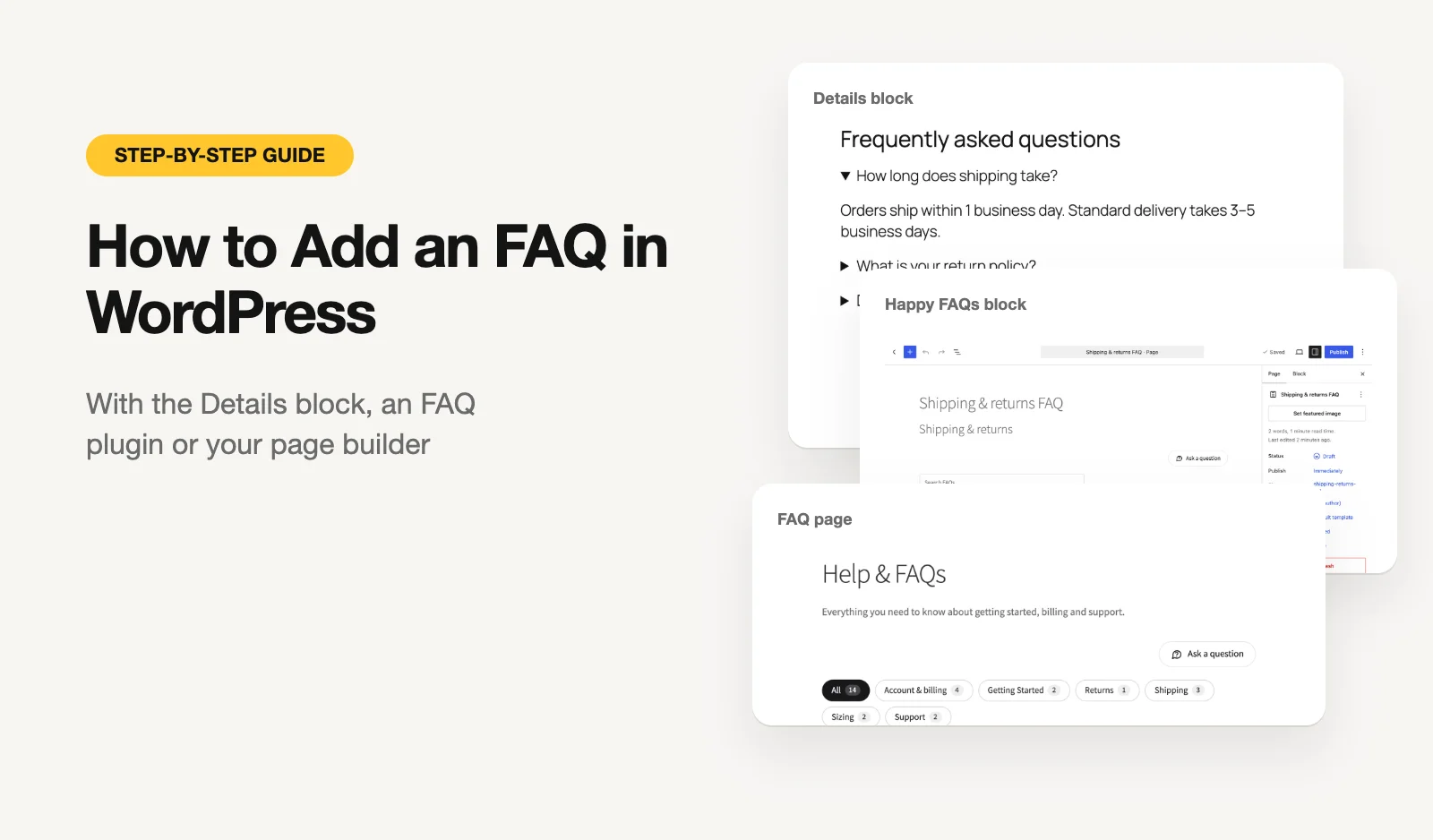
- You want questions that open and close: Happy FAQs, or WordPress's own Details block for a handful. Our guide on how to add an FAQ in WordPress shows both, step by step.
- You want a help center or support page: Happy FAQs.
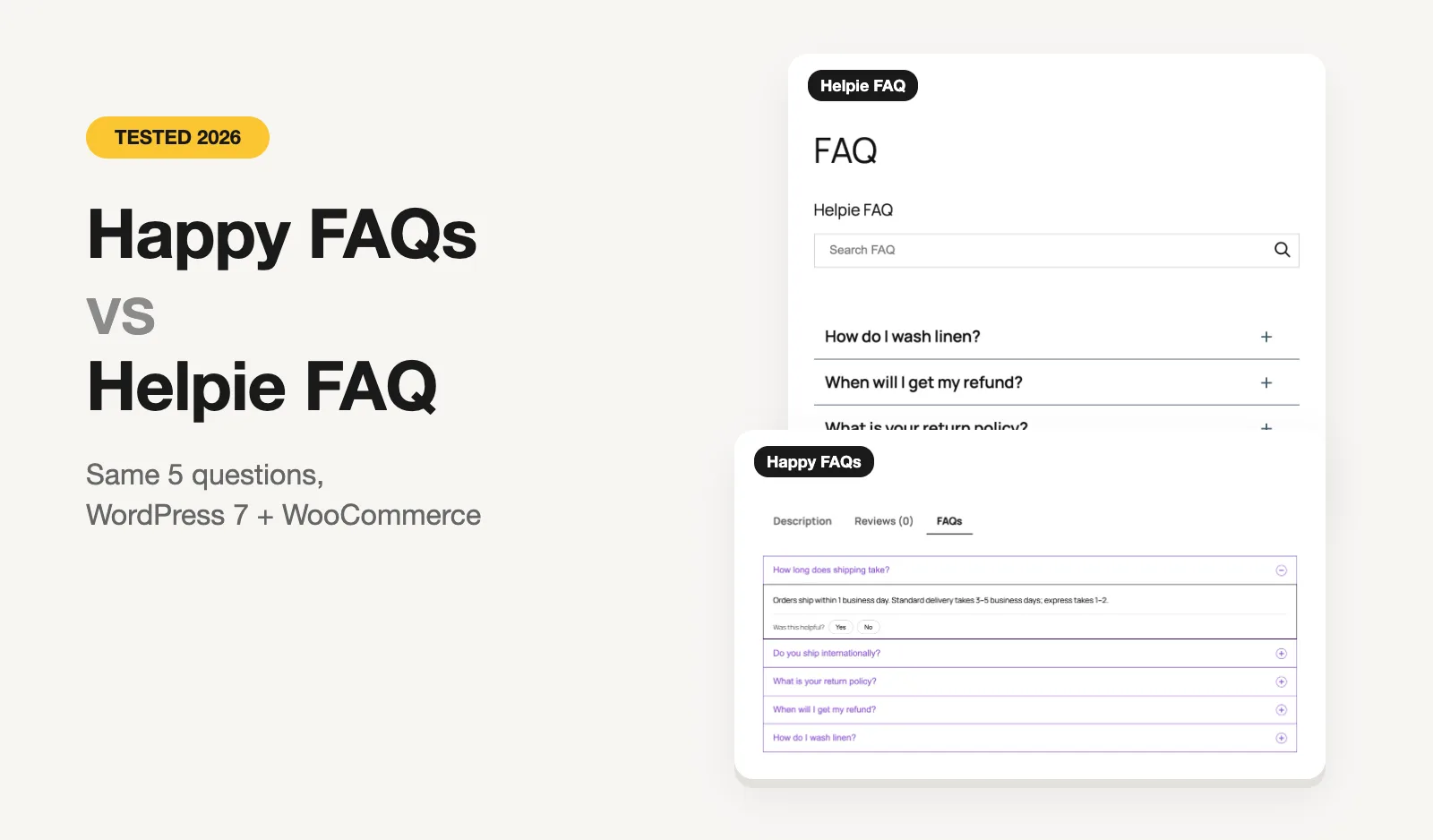
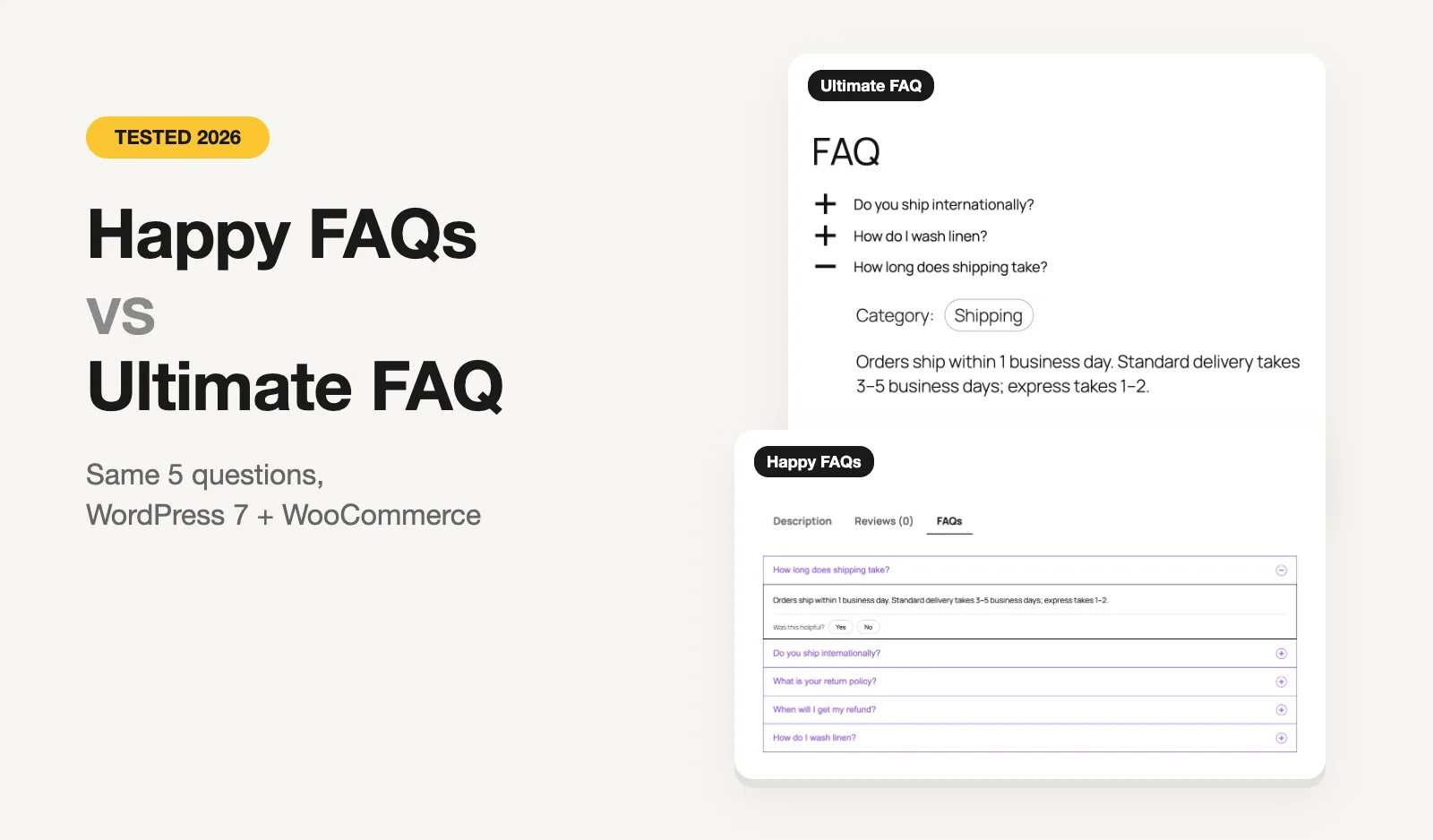
Comparing FAQ plugins? We tested six in the best WordPress FAQ plugins in 2026, and compared Happy FAQs with Easy Accordion, Ultimate FAQ and Helpie FAQ.